
Atlas Housing Download Series: Part 6 - From Housing Approvals to Housing Delivery: What Can We Do?

From Housing Approvals to Housing Delivery
Welcome to the final instalment of the #AtlasHousingDownload.
Across this series, we have explored some of the fundamental causes of the Australian housing market crisis. We’ve examined the structural imbalance between population growth and dwelling production, the limited capacity of Australia’s construction sector, the growing building rulebook, rental market volatility and the declining supply of subsidised housing.
We now arrive at the most important question: What do we do?
Governments have started responding
Housing policy has shifted considerably in recent years.
State governments are rezoning land, increasing permissible densities and establishing new pathways to approve housing more quickly. They are also investing in enabling infrastructure and seeking to make greater use of government-owned land.
At the Commonwealth level, net overseas migration is being brought down from its post-pandemic peak. Changes to negative gearing and capital gains tax settings are also intended to moderate demand for established housing and redirect investment towards new supply.
Government investment in social and Affordable Housing has also increased, recognising that the private market cannot meet the housing needs of everyone.
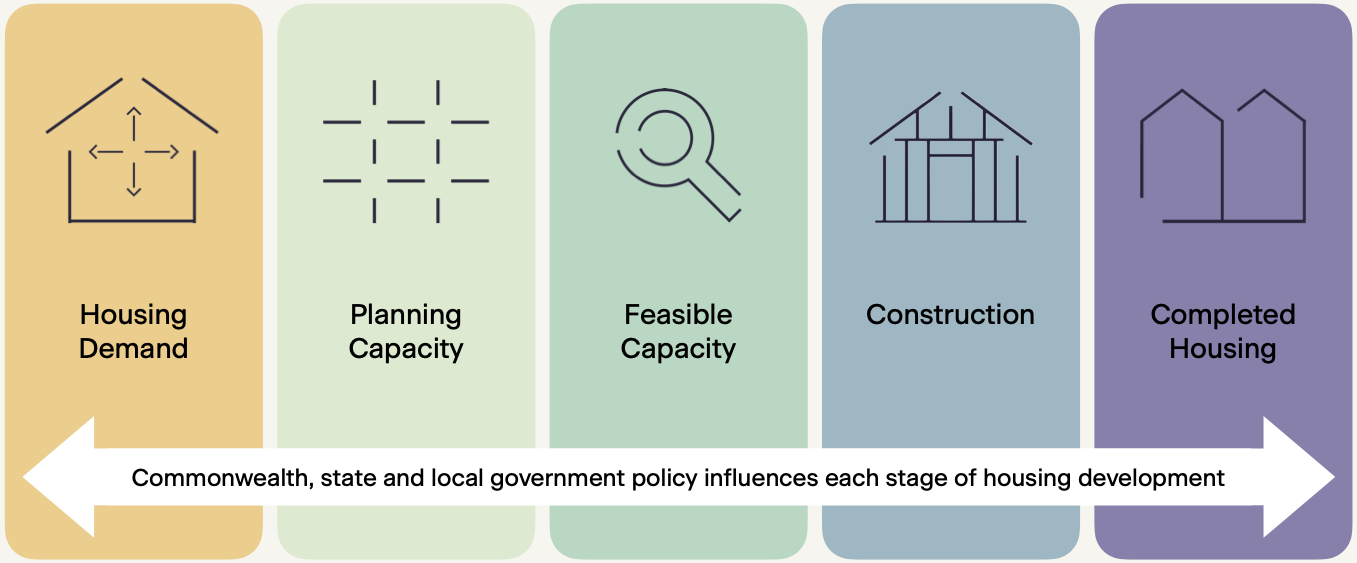
These reforms target different parts of the housing system:
- Migration settings influence the rate at which housing demand grows.
- Tax settings influence how and where capital invests.
- Planning reform determines where and how much housing may be developed.
- Infrastructure investment helps make development-ready land available.
- Subsidised housing supports those the private market cannot.
Each of these measures has a role to play. But none directly addresses the capacity of the industry ultimately responsible for building our homes.
Figure 1: From Demand to Delivery
We accidentally made housing a luxury good
We have an enormous number of people who need it, an enormous amount of land, an enormous construction industry, enormous amount of capital - yet somehow, we have managed to make housing incredibly difficult and expensive to produce.
Much of Australia’s housing debate is focused on planning approvals.
This is understandable. Restrictive planning controls, lengthy assessment processes and infrastructure constraints can prevent otherwise suitable land from being developed. Planning reform is therefore an essential part of improving housing supply.
But an approval is permission to build. It is not a completed home.
Before an approved project can be delivered, it must be commercially feasible, financed and physically constructed. Each stage introduces costs, risks and potential delays.
Increasing theoretical planning capacity does not automatically increase housing supply. The construction sector must have the capability and capacity to respond, and at a cost households can ultimately afford.
As we explored in Part 2 of the #AtlasHousingDownload, Australia’s performance on this measure is poor:
- The construction workforce and number of businesses increased by approximately 20% between 2016 and 2026.
- Yet the number of dwellings completed per hour worked declined by 53% over the past three decades.
- Today, 14 dwellings are completed per 100 workers (compared to 32 dwellings per 100 workers 50 years ago).
- Wages today are higher than 50 years ago, but we are producing less than half of what we did 50 years ago.
- In contrast, labour productivity across the broader economy increased by 49% over the same period.
Australia is employing more people and operating more construction businesses but delivering fewer homes per worker. We are asking an industry with poor productivity to deliver housing at an unprecedented scale. When the market is constrained in its capacity to produce, the market prices the constraints into the product.
Figure 2: Housing Construction and Economy-wide Productivity, 1995–2024
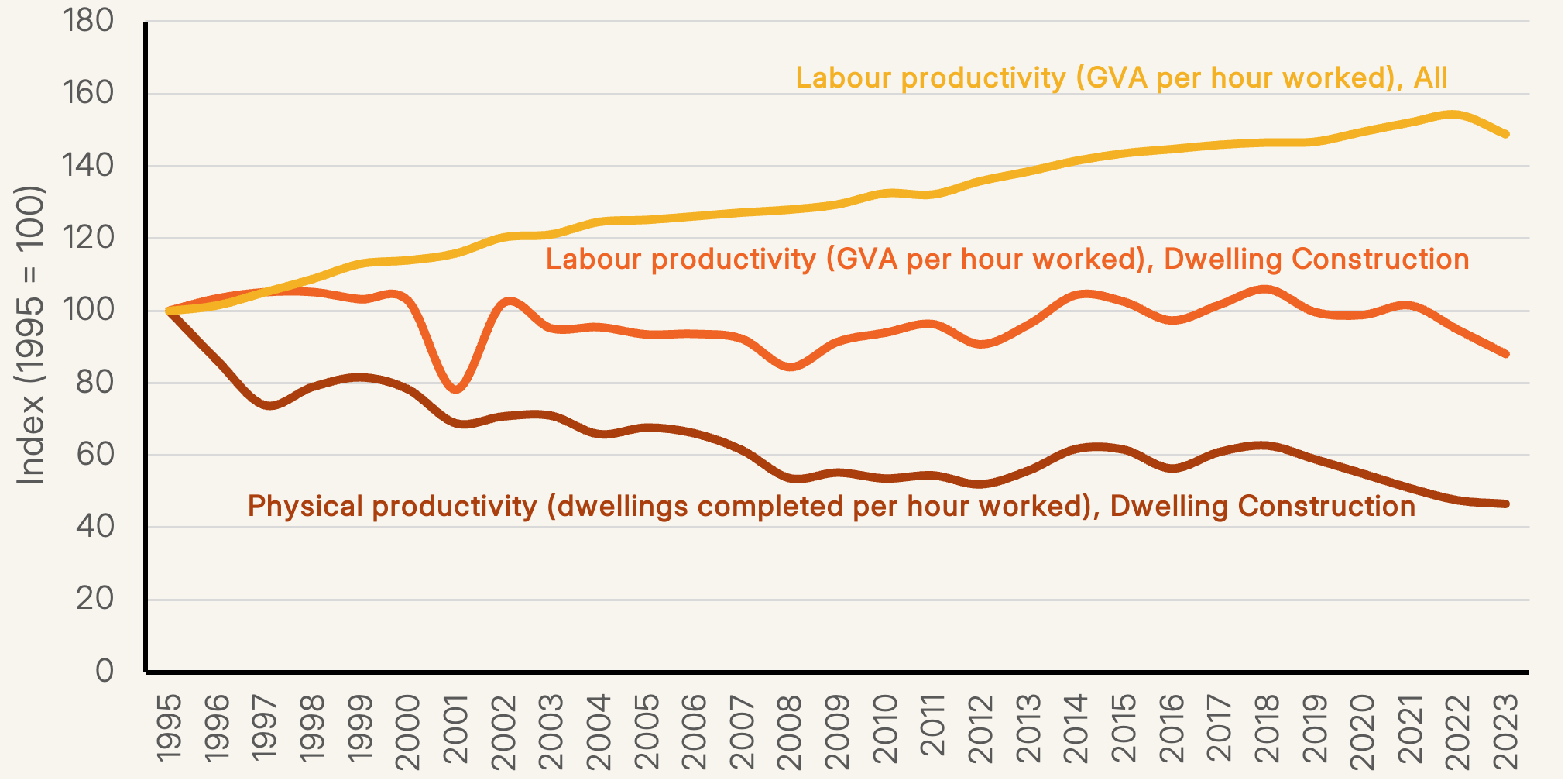
Source: Productivity Commission (2025)
The debate often centres around housing supply as though it is a tap we can turn on. It is not.
Construction capacity is an industrial capability. If we want to build twice as much housing, we need to double the productive capacity of the industry. It’s not just about “we need more labour”
Why system-wide productivity matters for affordability
Productivity often sounds and feels like an abstract economic concept. In housing, its effects are tangible.
Improving productivity means delivering more housing from the labour, capital, land and materials used. It can reduce construction times, improve the reliability of delivery and lower the cost of producing each dwelling.
But our construction sector is fragmented, with thousands of micro-firms making up the sector. The average construction firm employs 2.7 persons.
The sector has progressively shifted towards subcontracting and specialisation. While this could be efficient at the project level, excessive fragmentation makes it harder to achieve scale, standardisation, coordination and process investment needed to improve productivity across the construction industry.
The constraint is not simply the number of construction workers, but how effectively the industry can convert labour into completed dwellings. Though, productivity reform will not, by itself, resolve housing affordability. Where developable land remains constrained, some construction cost savings may be absorbed into higher land values rather than passed through.
A lower-cost of production must be system-wide, not at the project level. It is only a system-wide reduction in cost that will make housing cheaper to buy.
If we want cheaper housing, we must make housing cheaper to produce.
This is why planning reform and construction productivity should not be treated as mutually exclusive or policy alternatives. Planning reform creates opportunity and the availability of development sites. Construction productivity determines how efficiently those opportunities can be converted into completed homes.
International experience helps illustrate this relationship.
Auckland: Planning reform can increase supply
Auckland’s 2016 Unitary Plan substantially increased permitted residential densities across the city. Research has estimated that the reforms generated around 21,800 additional dwelling consents over their first five years (Greenaway-McGrevy and Phillips, 2023).
Importantly, more recent valuation and Census evidence (and subsequent scholarly reviews) indicates that this was not merely an increase in approvals. Auckland recorded substantial growth in its dwelling stock following the reforms, with around 84% to 90% of post-reform consents appearing to translate into net additional homes.
Figure 3: Housing Approvals, Auckland
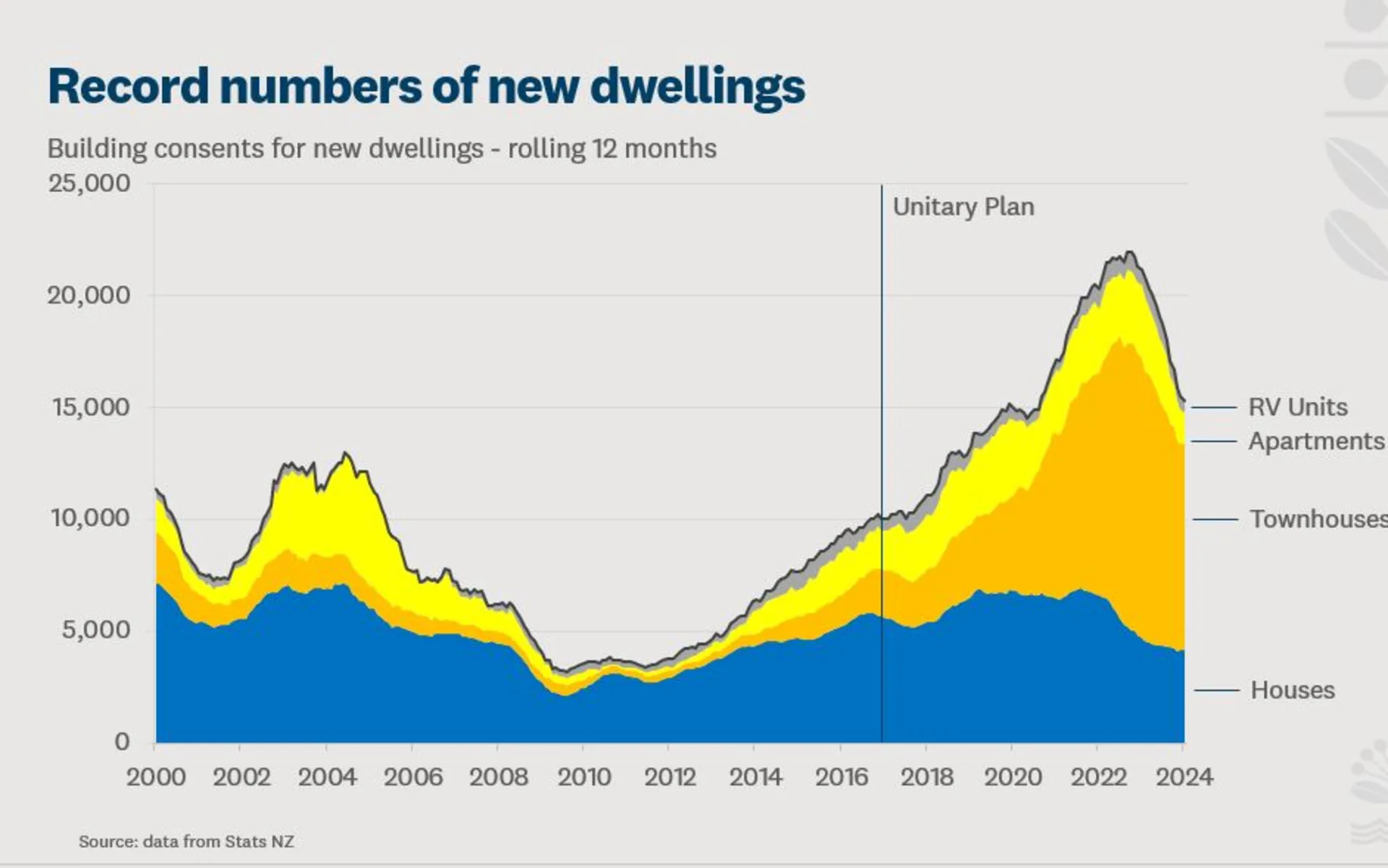
Source: RNZ - Auckland Unitary Plan improving housing affordability
Auckland therefore demonstrates that well-designed planning reform can unlock genuine housing supply. However, it also reinforces the importance of having a construction sector capable of converting additional development capacity into completed homes efficiently and affordably.
Singapore: Building differently
Singapore demonstrates what a sustained and coordinated construction-productivity agenda can achieve.
Over several decades, Singapore has progressively shifted parts of its construction industry from traditional on-site building towards Design for Manufacturing and Assembly (or DfMA).
Under this approach, components are designed for repeatable production in controlled factory environments before being transported and assembled on site.
Singapore’s strategy has included:
- Prefabricated and prefinished volumetric construction.
- Standardised structural and building components.
- Integrated construction and prefabrication hubs.
- Digital design and construction coordination.
- Productivity requirements for selected development sites.
- Public-sector procurement supporting modern construction methods.
- Investment in workforce capability, automation and accreditation.
Between 2010 and 2020, Singapore reported a 19.5% improvement in construction-site productivity. Its Housing and Development Board achieved a productivity improvement of approximately 25.9% over the same period.
These results should not be attributed to prefabrication alone. Singapore implemented a coordinated industry-transformation program encompassing technology, regulation, skills, manufacturing capacity and government procurement.
Figure 4: Singapore’s Construction Industry Transformation Map
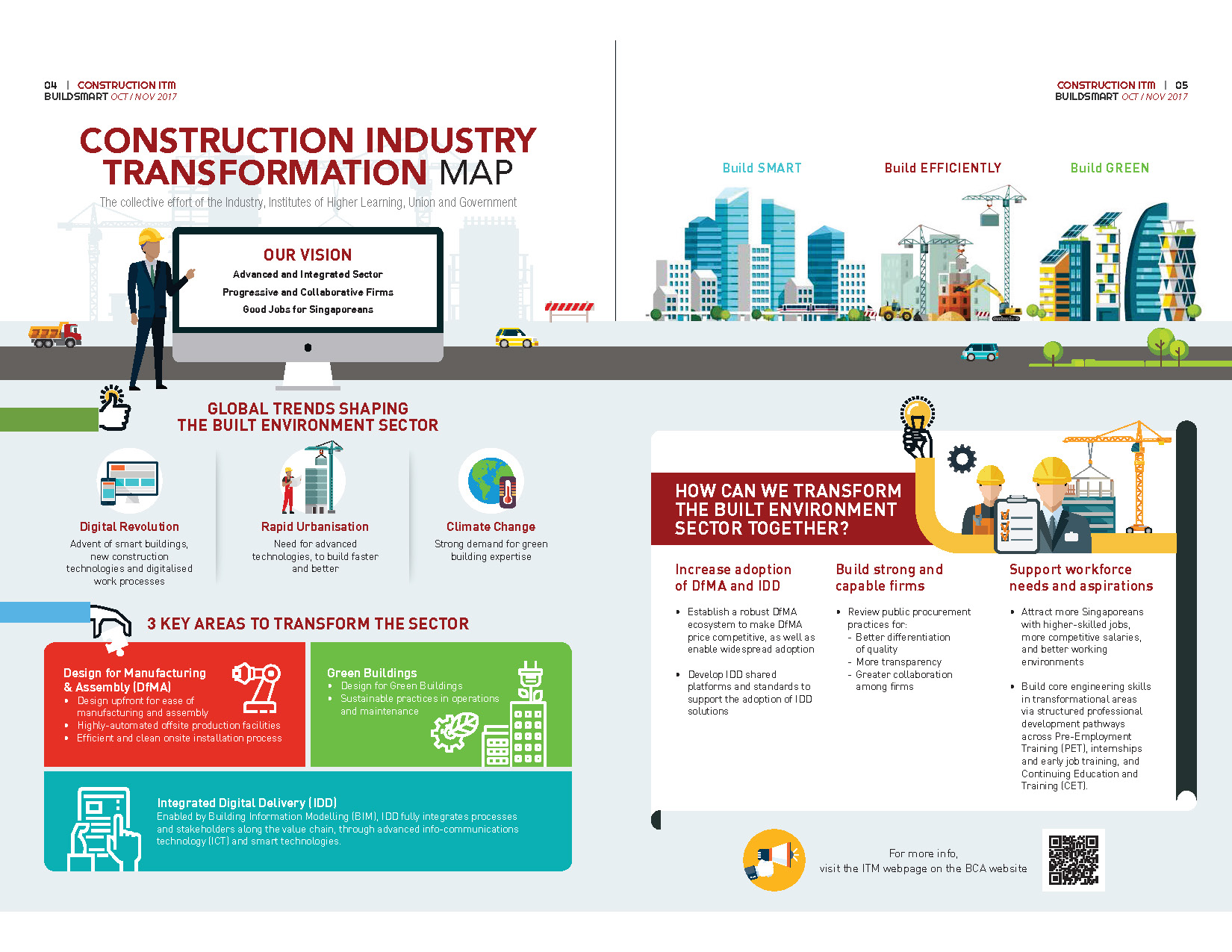
Source: Ministry of National Development (MND)
That is the important lesson for Australia. Modern methods of construction are unlikely to succeed as a collection of isolated pilot projects. Manufacturers require repeatable designs, interoperable building systems and a dependable pipeline before they can justify substantial investment in factories, equipment and workforce capability.
A National Construction Productivity Agenda
If Australia is serious about housing affordability, construction productivity needs to become a national economic reform priority.
This agenda should be built around three connected pillars.
1: Make housing production more repeatable
Most housing is still treated as a largely bespoke project. Designs, documentation, procurement processes and construction solutions are frequently re-created on each site.
Australia should increase the use of:
- Standardised building components, prefabrication and off-site manufacturing.
- Digital design, coordination and certification.
- National acceptance pathways for tested construction systems.
Standardisation does not require identical homes or neighbourhoods. The objective should be to standardise the parts occupants do not see while retaining flexibility in the parts they experience.
2: Create the conditions for productive scale
Investment in manufacturing facilities, automation, workforce training and digital systems requires a dependable pipeline of work.
Governments are among Australia’s largest clients of the construction sector. Their collective purchasing power could be used more strategically. Commonwealth, state and local government programs could:
- Publish coordinated, multi-year pipelines of social and affordable housing.
- Procure compatible components across multiple projects.
- Reward whole-of-program efficiency rather than assessing projects individually.
- Support open and interoperable systems capable of being supplied by multiple manufacturers.
- Link financial investment to measurable productivity improvements.
International experience demonstrates the risks of supporting manufacturing capacity without sufficient demand. The United Kingdom has seen several modular housing businesses fail despite the potential productivity benefits of the technology. Factories have high fixed costs and cannot operate efficiently on an ad hoc/ uncertain pipeline of bespoke projects. There will be no incentive to scale unless there is a bankable/ certain pipeline of work.
Government should help establish the market conditions for investment, not simply subsidise individual factories and hope that demand follows.
3: Create a genuinely national construction market
Anyone working in Australia’s construction sector knows Australia does not have a singular construction market.
Building regulations, occupational licensing, accreditation requirements and planning systems vary between jurisdictions. These differences limit workforce mobility, increase duplication and make it difficult for productive firms and construction systems to operate nationally. Reform should include:
- Greater consistency in occupational licensing and mutual recognition.
- More efficient recognition of overseas qualifications.
- Fewer unnecessary state variations to national building requirements.
- National recognition of tested prefabricated and modular systems.
- A comprehensive review of the cumulative cost of building regulation.
This does not mean abandoning legitimate safety, accessibility, sustainability or design objectives.
It means testing whether each requirement remains the most efficient way of achieving its objective and considering what the combined rulebook does to housing cost, feasibility and supply.
Measure delivery, not just approvals
Governments and industry bodies already monitor many aspects of housing delivery, including approvals, commencements, completions, construction costs, insolvencies and development timeframes. This work should continue and, where possible, be strengthened and consolidated into a clearer picture of how housing moves through the delivery pipeline.
Particular attention should be given to approval-to-commencement and commencement-to-completion times, conversion rates, construction costs and broader measures of sector productivity. Consistent public reporting would help identify where housing is being delayed or lost and whether reforms are improving completed supply, not simply expanding the pipeline of approved dwellings.
Australia must continue moving from measuring its ambition to build towards measuring its ability to deliver.
Planning reform or productivity reform? We need both
What the #AtlasHousingDownload has clearly shown is that Australia’s housing crisis does not have a single cause.
Population growth has increased demand. Household sizes have fallen. Planning systems have restricted supply. Infrastructure has not always kept pace. Construction costs have increased disproportionately due to a lack of industrial capability. Rental supply has become volatile. Many households require housing assistance, beyond what the private market can provide.
Addressing these issues requires multiple policy levers.
Planning reform creates the opportunity to build. Infrastructure and finance make development possible. Demand-side measures can relieve pressure, but without a supply response cause prices to rise. Subsidised housing supports those the private market cannot adequately serve.
But construction productivity ultimately determines how many homes Australia can physically deliver and at what cost.
Unless Australia can build more homes from its available resources, housing will continue to be a luxury good.
That is why it’s Atlas’ view that the National Construction Productivity Agenda should be tabled and endorsed at the National Cabinet. The National Cabinet should endorse a rolling five-year 'National Construction Productivity Agenda'. This should consolidate the work already occurring across governments into a single program with clear ownership, measurable outcomes and public accountability. We DO NOT need another review.
This would be a logical extension to the National Housing Accord. If National Cabinet can agree on how many homes Australia needs, it should also agree on how the construction sector will deliver them.
We agree that approving more housing matters. Building them efficiently and affordably matters just as much.
That is the next, and arguably most difficult, housing reform Australia must confront.

References
Australian Government (2025). Treasurers Agree Reforms to Increase Competition and Boost Productivity
Building and Construction Authority Singapore (2022). Built Environment Industry Transformation Map to Facilitate Integration and Collaborative Breakthrough Across the Entire Value Chain
Committee for Economic Development of Australia (CEDA) (2025). Size Matters: Why Construction Productivity Is So Weak
Donovan, S. and Maltman, M. (2024). Dispelling Myths: Reviewing the Evidence on Zoning Reforms in Auckland. Motu Working Paper 24-07.
Greenaway-McGrevy, R. and Phillips, P.C.B. (2023). The Impact of Upzoning on Housing Construction in Auckland. Journal of Urban Economics, Vol. 136.
Housing & Development Board Singapore (2022). HDB Pilots Advanced Construction Technologies to Design and Build Flats in Further Push to Raise Construction Productivity
Jones, J.A., Greenaway-McGrevy, R. and Crow, C. (2025). Using Council Valuation Records to Estimate Auckland’s Housing Stock. Policy Quarterly, Vol. 21, No. 1.
Productivity Commission (2025), Housing Construction Productivity: Can We Fix It?
UK Infrastructure and Projects Authority (2021). National Infrastructure and Construction Pipeline 2021
Related posts
Dive deeper into insights that matter to you.

Atlas Housing Download Series: Parts 1-6

Atlas Housing Download Series: Part 5 - Beyond Welfare: The Case for Subsidised Housing

Atlas Housing Download Series: Part 4 - Volatility of Rental Supply and Impacts on Rents

Atlas Economics is now a proud and excited partner of the Goodes O’Loughlin (GO) Foundation!
Make smarter decisions
Get in touch with the Team to get an understanding of how we transform data into insightful decisions. Learn more about how Atlas Economics can help you make the right decisions and create impact using our expertise.