
Atlas Housing Download Series: Part 3 - Regulatory Change in Building Requirements and Cost Implications
.png)
Regulatory Change in Building Requirements and Cost Implications
Welcome back to the Atlas Housing Download. We left you last time with Part 2 of the Atlas Housing Download, which explored both the capacity and capability of Australia’s construction sector and how this is influencing our ability to deliver housing supply. In Part 3, we consider a topic that doesn’t often get the same coverage that factors like planning, land availability or feasibility do in the housing conversation: the steady expansion of the rulebook that governs how we design and build homes.
The Growing Rulebook
The rulebook has become longer, broader and harder to navigate.
- Over the past few decades, Australia has progressively layered new requirements onto housing in pursuit of legitimatepolicy goals: better energy performance, improved accessibility, stronger fire and safety outcomes, and higher design quality.
- Most of these reforms were introduced for good reasons. Better thermal performance can lower running costs. Better accessibility can make housing more usable over the life cycle. Better design standards can improve amenity. But there is a trade-off: each additional layer of regulation can add construction cost, consultant cost, design complexity and approval burden.
- A basic but nevertheless useful proxy for the growing complexity of building regulations can be seen in the growing size ofthe National Construction Code (NCC) compared to the former Building Code ofAustralia (BCA).
- Since 1988, an additional 675 pages of regulations govern how residential buildings are delivered. More pages usually (any more rules) intrinsically require more interpretation and more consultant input.
Figure 1: BCA/NCC Volume One (1988-2022), Page Counts
%2C%20Page%20Counts.png)
Source: ABCB (2026)
30 Years of Added Requirements
The issue is not one regulation – it is the cumulative effect of many.
- New housing requirements have been layered in progressively over decades rather than introduced in one major reform.
- Major milestones include NatHERS in 1993, the performance based BCA in 1996, BASIX in 2004, the creation of the NCC in 2011,
- NSW and Victorian apartment design reforms in 2015 and 2017, and later energy and livable housing uplifts under NCC 2022.
- Each reform may have been introduced for a sound policy reason, but together they have increased the number of standards that housing projects need to satisfy.
Figure 2: Major Regulatory Milestones (1990-2025), Australia’s Construction Sector
%2C%20Australia%E2%80%99s%20Construction%20Sector.1.png)
Source: Various – see reference list
Then v Now: The Walk-Up Apartment
The efficient and affordable walk-up is not necessarily banned, but it is far harder to deliver economically.
- The most prominent victim of growing building regulation has been the humble ‘walk up’ apartment building which was prolific across Australia’s cities in the early 20th century.
- Walk up flats were generally straightforward to deliver, featuring simple stairs, compact floor plates, minimal common circulation and no lift, making them a relatively efficient and affordable housing format.
- Whilst walk up flats are not necessarily banned under current regulations, NCC accessibility requirements to common areas, liveable housing provisions and higher design standards around amenity, solar access, ventilation, storage and private open space mean that this typology is now much harder to reproduce in its historic form, even where it remains technically possible.
Figure 3: Examples of the Classic ‘Walk Up’ Apartment Building

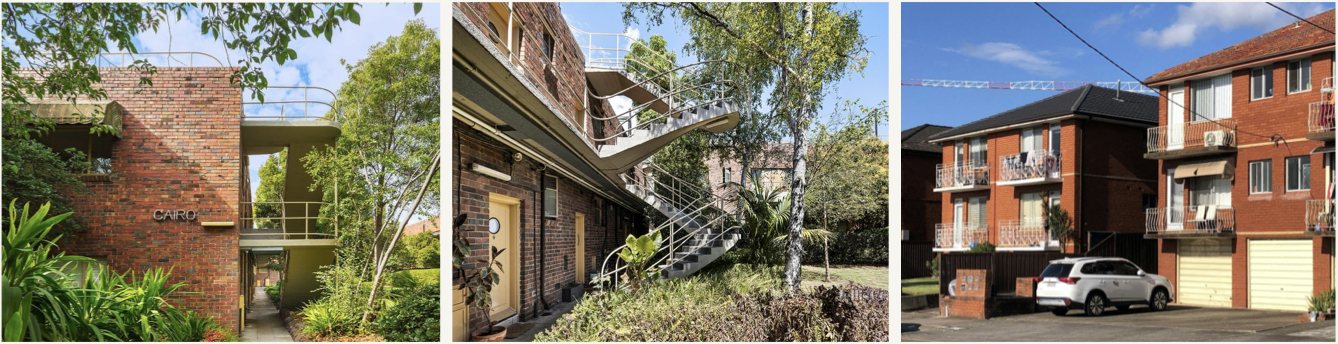
Source: Cairo Flats (2026)
Note: Diagram of ‘Cairo Flats’ Nicholson Street/Hanover Street, Fitzroy, Melbourne
Compliance has a Cost
The rulebook does not affect every housing type equally.
- Construction costs vary materially across Class 1 and Class 2 housing typologies, with higher-density formats bearing more complex design, access, servicing and compliance requirements. This is reflected in soft costs like professional fees.
- This means the cost of compliance is not uniform across the housing market, with some typologies are far more exposed to regulatory complexity than others.
- For instance, lower rise apartment buildings are typically more expensive to deliver than mid rise apartment buildings on a dollar per square metre of gross floor area (GFA) basis, as they lack density needed to ‘spread’ this cost. This has direct implications for the deliverability of ‘gentle density’ which is so often called for in existing urban areas.
Figure 4: Average Building Costs ($/sqm GFA) and Densities, Class 1 and Class 2 Buildings
%20and%20Densities%2C%20Class%201%20and%20Class%202%20Buildings%20v2.png)
Source: Atlas Economics/Altus
Quality Gains v Supply Effects
Better standards can improve the quality of homes, but they can also reduce affordability and supply.
- Higher standards can deliver genuine benefits, including better thermal performance, stronger resilience, improved accessibility and better apartment amenity which lead to health and wellbeing outcomes.
- But as requirements accumulate, the incremental quality benefits diminish while the cost on feasibility, dwelling yield and supply responsiveness accumulates.
- The policy challenge is not whether standards matter. It is whether governments are properly confronting the trade-off between better homes and homes that remain feasible to deliver at scale.
Figure 5: The Trade-Off of Added Regulation on Housing Supply, Conceptual Illustration

Note: this figure is conceptual and intended to illustrate the potential trade-off between cumulative regulation, housing quality and supply responsiveness.
Source: Atlas Economics
Better Homes Matter. So Does Affordability
Better homes matter. Safer, more sustainable, more accessible and better-designed housing delivers real benefits to residents and communities. Most of the reforms added to Australia’s housing rulebook over recent decades have been introduced with good intentions. But these reforms are not without cost. As requirements accumulate, they can increase design complexity, reduce efficiency and weaken project feasibility.
If Australia is serious about affordability, housing policy cannot just keep adding new requirements. It must consider the incremental benefit compared to the incremental cost. It must confront what those requirements do collectively to feasibility, delivery efficiency and the ability to supply homes at scale.
Next Instalment
To this end, Part 4 of the Atlas Housing Download will be exploring the impact of volatile housing supply on our rental markets.

References
Australian Building Codes Board (2026). Editions of the National Construction Code
Australian Building Codes Board (2022). NCC 2022 Volume One
Australian Building Codes Board (2022). Overview of changes – energy efficiency and condensation
NCC News, 1 September 2022.
Australian Building Codes Board (2022). New whole-of-home energy efficiency – what’s it all about?
NCC News, 10 October 2022.
Australian Building Codes Board (2022). Apartment energy efficiency – what’s new for 2022?
NCC News, 10 October 2022.
Australian Building Codes Board (2022). New liveable housing design requirements
NCC News, 21 June 2022.
Australian Building Codes Board (2022). Livable Housing Design Standard
Cairo Flats (2026). Cairo Flats History
Nationwide House Energy Rating Scheme (NatHERS). About NatHERS
NSW Department of Planning, Housing and Infrastructure. Apartment Design Guide
NSW Department of Planning, Housing and Infrastructure.
Design Quality of Residential Apartment Development – Planning Circular PS 15-002
NSW Department of Planning, Housing and Infrastructure.
Sustainability standards for residential development (BASIX)
NSW Department of Planning, Housing and Infrastructure. Sustainable Buildings SEPP
The Conversation (2021). Remaking our suburbs’ 1960s apartment blocks: a subtle and greener way to increase housing density
Victoria Department of Transport and Planning (2026). Better apartments design standards
Victoria Department of Transport and Planning (2017). Apartment Design Guidelines for Victoria
Related posts
Dive deeper into insights that matter to you.
Atlas Housing Download Series: Parts 1-6

Atlas Housing Download Series: Part 5 - Beyond Welfare: The Case for Subsidised Housing
Atlas Housing Download Series: Part 6 - From Housing Approvals to Housing Delivery: What Can We Do?

Atlas Housing Download Series: Part 4 - Volatility of Rental Supply and Impacts on Rents
Make smarter decisions
Get in touch with the Team to get an understanding of how we transform data into insightful decisions. Learn more about how Atlas Economics can help you make the right decisions and create impact using our expertise.